First published: December 2025
From a family of artists, Gertrude Honzatko-Mediz created in collaboration with her father – as well as with her mother from beyond the grave
[In 1893, a few months after Gertrude Honzatko-Mediz was born, her parents decided to leave their small Austrian town of Krems and settle in Dresden. They were both artists and hoped to succeed in the German metropolis with its vibrant art scene. Her mother, Emilie Mediz-Pelikan, made no secret of her desire to live exclusively for art, and her adoring husband, Karl Mediz, followed suit. While they pursued their artistic vocation far from home, their daughter remained in the care of her grandmother in Krems. She had a loving, supportive upbringing with her grandmother encouraging her creative talents, as she had done for her daughter; however, the almost constant absence of her parents did not leave young Honzatko-Mediz unscathed.

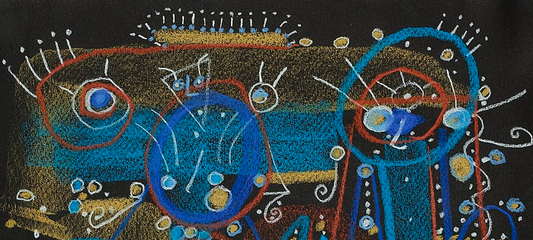
Death and the Greedy Man, 1910, charcoal and pastels on paper, 12 x 14.5 in. / 30 x 45 cm
Her mother died unexpectedly at the age of 46 in 1908, leaving Karl Mediz lost and without meaning nor purpose. Emilie Mediz-Pelikan had been the more creative of the couple – the constant source of inspiration – and without her driving force, he was plunged into a creative crisis.

Untitled (“commissioned” by Honzatko-Mediz’s mother from beyond the grave), 1910, ink and pencil on paper, 12 x 8.5 in. / 31 x 22 cm
In 1910, Honzatko-Mediz’s aunt, Josefine Reischl, her mother’s sister, began to host spiritualist séances in her house in Krems, with a medium called Marie Pfeifer. Within a few weeks, the life of the 16-year-old Honzatko-Mediz was turned upside down. The séances escalated into highly dramatic performances which she wrote about in great detail in her diary as well as in a long letter to her father in Dresden. She described how various spirits spoke and wrote through the entranced Pfeifer who laughed, cried, ran around the house, danced, writhed on the floor in pain, and talked about the landscapes of the afterlife.

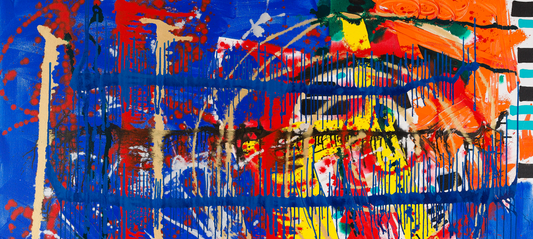
Saturn Landscape, 1910, chalk, watercolour and ink on paper, 19.5 x 13.5 in. / 49.5 x 34.5 cm
By ELMAR R GRUBER
This is an article extract; read the full article in Raw Vision #125.