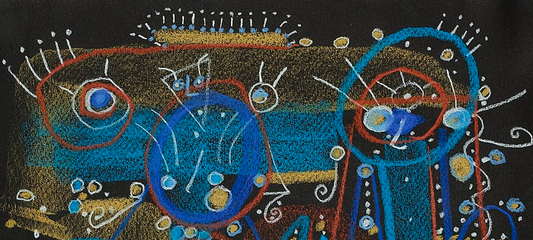
Six decades into a life shaped by hardship and resilience, Hélène N. began to draw women’s faces, and did not stop for a decade
From a small, wheeled shopping trolley, a smiling septuagenarian pulls out sheets of paper, nearly a hundred tightly framed portraits of women. A small crowd begins to gather as she lays her drawings out on the ground. The largest are roughly A4 in size; others defy measurement, their edges irregular, cut and re-cut. In the anonymity of a town square alive with constant movement, the woman offers her works for a few symbolic euros.

Hélène N. – she does not divulge her real name – was born to Sicilian-French parents in 1947 in Algeria, when it was a French colony, in Philippeville, a city whose name changed with history. By the time she was 13, the political context had led her parents to move her and her four siblings to France, to Massy-Palaiseau, a suburb south-west of Paris.

77 of Hélène N.’s drawings on show at Librairie Sans Titre in Paris, 2026; photo: Estelle Hanania
For much of her life, Hélène has suffered a mental illness which, for many years, remained undiagnosed. A complex person, with a resilient life force, a vivid imagination and a passion for the arts, she roamed the museums and cinemas of Paris, and immersed herself in the world of music. She married young and had two daughters, and it was not until many years later – when she was in her sixties – that a crisis in her mental health led to an extended period of hospitalisation. It was then that Hélène began to draw, to see women’s faces “come under [her] hand”, as she describes it.

“First I drew a Chinese woman, then a man with a cigarette and a cap – like Corto Maltese, you know,” she says, referring to the seafaring protagonist in an Italian comic book series dating back to the 1960s. “A blue-black room. The orange of that time. A gallery owner had photographed the apartment. Then I kept entering the world of certain painters. You know, I saw strange things – painters from the Italian schools – Tintoretto, Titian, Veronese, all those artists you can admire in the Louvre, in the gallery behind the Mona Lisa – I’d go into my room, and there’d be an orange light with a curtain in front of it, and behind the curtain, an old man from another era, asleep. ... “...I found myself in the world of certain painters. It was a bit frightening’” Hélène continues, “because I was in my own room, and I saw old people lying there. I told myself, don’t be afraid, you’re in the bedroom of someone who lived a very, very long time ago.”
By LAURE FERNANDEZ
This is an article extract; read the full article in Raw Vision #127.