Born from Jean Dubuffet’s extraordinary donation of outsider creations, the Collection de l’Art Brut celebrates its 50th anniversary, looking back and forward
The elegant, understated building that houses the Collection de l’Art Brut sits in the urban landscape of the Swiss city of Lausanne. Originally a patrician residence dating from the eighteenth century, it has been the home of the Collection – which celebrates its 50th anniversary this year – since 1976.

The Collection de l’Art Brut building today
To quote Jean Dubuffet, an artist himself and the first theorist and collector of art brut, “True art is always where you least expect it.” Thanks to the establishment of the Collection de l’Art Brut, thousands of visitors have been able to find the huge body of art that he amassed. The Collection’s renown and popularity have grown over the last half century and today the museum attracts more than 40,000 people a year from around the world. On first entering the building, one is struck by the black walls, the antithesis of the White Cube aesthetic of contemporary art scenography. This intimate atmosphere has remained unchanged since the museum opened and the 300 works in the 50th-anniversary exhibition stand out as vivid against the dark walls as they did in 1976.

Adolf Wölfli, Untitled (Le Lac et les Îles), 1917, graphite and coloured and pencil on paper, 27 x 20 in. / 68 x 51 cm
“In this celebratory exhibition, I wished to show chief figures of outsider art, like Aloïse Corbaz, Adolf Wölfli and Heinrich Anton Müller, but also artworks never presented so far and newly discovered creators, such as Diego de Mauri and Pascal Vonlanthen, because they illustrate how the notion of art brut is still very relevant and alive today,” says Sarah Lombardi, director of the Collection de l’Art Brut since 2013. The exhibition explores the story of art brut, old and new, and how its renown spread across the world, moving from the margins to become an integral part of contemporary art, the makers leaving behind anonymity to be recognised as artists, inspiring others in different artistic fields.

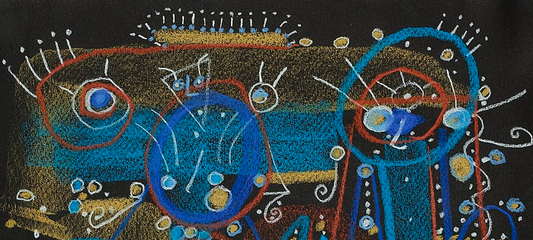
Pascal Vonlanthen, Untitled, 2019, felt pen and Indian ink on paper, 27.5 x 19.5 in. / 70 x 50 cm
In the 1975 film Aloïse, French actress Isabelle Huppert took on the role of the eponymous artist and visited the Collection de l’Art Brut several times, saying that it “raises so many questions about normality and folly” . Indeed, when Aloïse Corbaz was 28 years old she was interned for life in a then-called mental asylum, going on to an existence, not only of seclusion, but also of intense creativity, producing a corpus of 3,000 pieces.
The work of Aloïse has been part of the Collection since its inception, the seed of which was sewn decades earlier with a journey made by Jean Dubuffet in 1945. In the aftermath of World War II, Dubuffet was invited to Switzerland by a group of intellectuals, medical professionals and artists. During the trip, he visited prisons and asylums, where doctors showed him creations that would go on to constitute the nucleus of what he would later theorise as art brut. In 1971, after decades of gathering artworks, he donated his collection of more than 5,000 pieces, by 133 creators, to the Swiss city of Lausanne. The Collection de l’Art Brut museum opened five years later with Michel Thévoz as its first director. Thévoz recalls, “At the time, we asked ourselves if the Collection was finished, if new creators were still to be discovered. We betted for the latter option” . Five decades on, the Collection comprises 70,000 pieces, with about 1000 in the permanent exhibition.
By CHLOÉ FALCY
This is an article extract; read the full article in Raw Vision #127.