First published: March 2026
With its unique roots and context, outsider art in Canada was undefined and overlooked for years – but now it is coming out of the shadows
Canada is new to the conversation about
outsider art. The terms “primitive” , “folk” , “naïve”
and “provincial” were once used to describe
idiosyncratic creators like Quebec artist Arthur Villeneuve
and Toronto-based Scottie Wilson, with the term
“outsider” only introduced comparatively recently. Not
surprisingly, appreciation and interpretation of the genre
varies across the vast country, reflecting both its
European roots and its proximity to the USA.

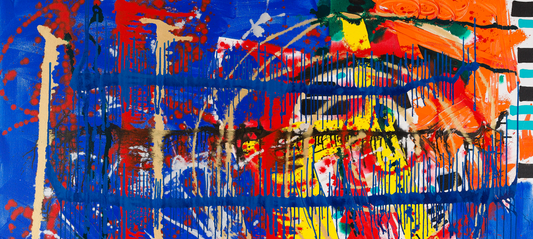
Menno Krant, Untitled, 2000, acrylic and oil on canvas, 36 x 36 in. / 91.5 cm x 91.5 cm
Today, outsider art in Canada is not seen as a branch
of folk art, but regard for that genre surely paved the
way for its acceptance, and discussions about outsider
art often start there. The creations of self-taught
immigrant pioneers – with themes of seafaring life in
the Atlantic provinces, Quebec’s claim to generations
of les patenteux (inventive tinkerers), and veneration
for the art of settlers in farming communities – are also
key to the subject. As Jean Dubuffet was proposing his
anti-cultural manifesto with his collection of art brut,
Canada was experiencing post-war immigration and
growing ethnic diversity which – alongside changing
social values, the threat of American cultural imperialism,
Quebec sovereignty debates, and Indigenous land claims
– led to the government proclaiming legislation of
opposite: William Kurelek, Where Am I?, 1953–1954, watercolour
on paper 23 x 29 in. / 58.5 x 73.5 cm
multiculturalism. During this time, the work of self-taught
artists contributed to a uniquely Canadian identity,
particularly folk artists like Maud Lewis. It is important to
note that the art of Canada’s Indigenous population (First
Nations, Inuit, Métis), does not sit in the outsider world; it
inhabits an art world of its own.

The Maze, 1953, gouache on board, 47.5 x 36 in. / 121 x 91 cm
Most European art brut collections include a body of work by artists with disabilities and mental health issues – but this is not so in Canada where psychiatric institutions were closed decades ago during the global deinstitutionalisation movement. While there are, of course, prolific Canadian artists who live with both mental and physical disabilities and illness, there are no publicly accessible collections of art by these artists and so their work is not as visible as it is overseas.

Guardian of the East, c. 1965, pen and coloured ink on paper, 31 x 24.5 in. / 78.5 x 62.5 cm
By LINDA RAINALDI
This is an article extract; read the full article in Raw Vision #126.